
Helen’s mobility journey began in childhood. In 1982 at just five years old, Helen was diagnosed with osteosarcoma in her right leg and had to undergo an above knee amputation.
In the 80s prosthetic technology was still in its early stages, so Helen had to learn to walk using a basic wooden limb which placed significant strain on her remaining left leg. But this didn’t stop Helen. She explains: “Despite ongoing medical challenges throughout my life, I remained determined. I was often unwell as a child and missed significant time at school, but with the support of my friend Joanne who helped me keep up with my studies, I went on to achieve my GCSEs and continued my education at college.”
Unfortunately, Helen’s mobility difficulties were impacted by a road traffic accident in 1996 where she sustained a significant fracture in her left knee which never fully healed. Then in 2000, while 36 weeks pregnant, Helen suffered from a fall which significantly worsened the damage to her knee. She adds: “I was rushed for an emergency caesarean section, followed five days later with surgery to repair the fracture along with associated tendon and ligament damage.”
As an above knee amputee, rehabilitation was particularly complex for Helen. “It took approximately 12 months for me to regain mobility, during which time I was also caring for my newborn daughter,” Helen explains. “That experience has stayed with me - I learned to walk again alongside my daughter, Lola, as she took her first steps.”
For the following 25 years, Helen lived with chronic pain and instability in her left knee, alongside other ongoing medical conditions. Her mobility gradually declined, particularly from around 2019 when she began experiencing frequent falls due to the knee giving way. This was managed conservatively with steroid injections, alongside increasing reliance on crutches and a wheelchair but over time, her strength and independence reduced significantly.
A life-changing surgery
On 15th December 2025, Helen underwent a total knee replacement and patella repair at the Royal Orthopaedic Hospital in Birmingham. This wasn’t a straightforward knee replacement as Helen had relied on her left leg as her only weight bearing leg since she was five years old.
She comments: “Given that my left leg is my only weight bearing limb, this presented a unique and highly complex rehabilitation challenge. The surgical, physiotherapy and nursing teams have provided exceptional care throughout my admission. However, my early post-operative experience was far more challenging than I had anticipated.
“The pain in those first days was intense, constant, and unlike anything I had experienced before. It felt relentless and all consuming, and at times it reduced me to tears, something I am not used to. For the first time in my life, my usual mindset of simply getting on with it was not enough.”
Standing on two feet
It’s important for patients who have had a knee replacement to start weight bearing when they can, with the right support, as this can promote healing in the muscles and the joint. For an amputee however, this brings additional challenges. Before Helen could even put on her prosthetic leg she had to stand unsupported on her newly operated leg. This is because her prosthesis is suction fitted, meaning Helen has to be able to stand upright to put it on.
Helen explains: “Standing for the first time less than 24 hours after surgery, bearing weight solely through my operated leg, was one of the most difficult moments I have ever faced. I remember feeling a sense of shock at the intensity of it, and there were moments where I genuinely questioned how I would get through the recovery ahead. It took several attempts over a number of days and it was one of the hardest parts of my recovery.
“My physiotherapist, Chris, and the team were phenomenal, adapting everything around my individual needs and supporting me every step of the way. With the unwavering support of the team around me, I was able to take those first steps. It took every bit of determination I had, but gradually I began to rebuild both my physical strength and my confidence.”
Helen adds: “From the first time my surgeon, Mr Shakir Hussain, came to see me just hours after surgery, he gave me complete confidence that my new knee was strong, stable and capable of supporting me. Because it is my only weight-bearing leg, that reassurance meant more than I can put into words and gave me a solid foundation to build my recovery on. His words became my anchor. Whenever I doubted myself or questioned my progress, I came back to what he had told me. Knowing he had complete confidence in his work allowed me to begin believing in my knee again. His confidence became the foundation for my own, giving me the belief to trust the process, keep pushing forward and gradually rebuild trust in the only leg I have ever relied upon.”
A key priority for Helen was returning home in time for Christmas, to spend time with her family and her first grandchild who was born earlier in 2025. “Thanks to the coordinated efforts of the team, all necessary equipment and support were arranged quickly and efficiently, enabling me to be safely discharged on 23rd December. I am incredibly grateful for the dedication shown in making this possible.”
Slow and steady recovery
“Since returning home, my husband and daughters have been my main support system, assisting with my care and rehabilitation,” she adds. “Physiotherapy is ongoing, and I have also completed several sessions of hydrotherapy, which has supported improvements in my knee movement and strength.”
As Helen wasn’t fully mobile prior to surgery, her recovery began from a low baseline. She explains: “In the early stages, I relied on a frame to mobilise. I have since progressed to using crutches, which has been a significant milestone in my recovery.”
“Progress is steady but not always easy. There are days when the pain and fatigue feel overwhelming, and even getting out of bed is a challenge. However, I remain committed to my rehabilitation. I continue to complete my exercises and push forward, knowing that consistency is key to regaining my strength and independence.”
Helen adds: “Encouragingly, for the first time in many years, the chronic pain and instability in my knee has significantly improved. While some discomfort remains, particularly around the patella, the overall stability of the joint has been life changing.”
Learning to walk with purpose
Helen’s journey has now come full circle. The daughter she once learned to walk alongside has had a baby of her own, and Helen is now learning to walk again, this time with her grandson, Leo, as her motivation.
“This time, I am not just learning to walk again, I am learning to walk with purpose, with hope, and with a future in mind. I am working towards greater independence, focusing on small but meaningful achievements, from standing for daily tasks to increasing mobility within my home and reducing reliance on a wheelchair.”
Helen’s rehabilitation journey is still ongoing, and she is currently awaiting further input from a prosthetics specialist to optimise her gait and long-term mobility. “My goal is to regain as much independence as possible and return to an active role within my family, to be present, not just watching from the sidelines. Above all, I hope to one day walk hand in hand with my grandson.”
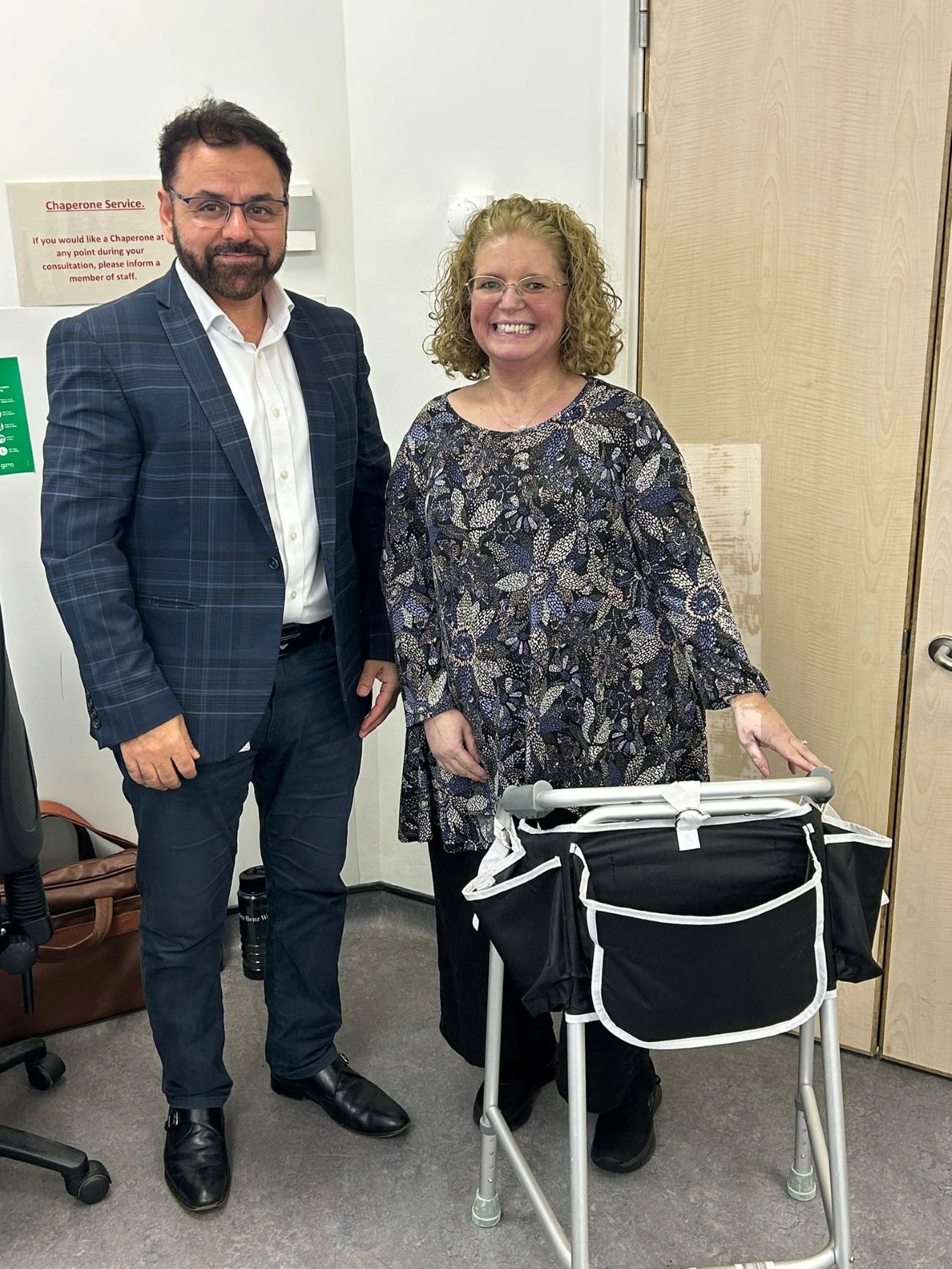
Helen and her Consultant Orthopaedic Surgeon, Mr Shakir Hussain
The emotional impact of major surgery
Going through a major surgery that will impact someone’s identity or body image can be really scary and years of chronic pain takes its toll mentally. Helen found that while her knee replacement was a huge success physically, she wasn’t prepared for the emotional impact of the journey.
“As an above-knee amputee, my left leg has always been my only weight-bearing leg. It is the leg that has carried me through childhood cancer, amputation, raising my family, and every challenge life has thrown at me. Over the years, I developed a deep attachment to it because so much of my independence depended on it.
“Yet for more than 25 years I lived with chronic pain following multiple injuries and surgeries. As my mobility gradually deteriorated, I spent years worrying about whether I would eventually need a knee replacement and whether my only good leg would continue to support me.”
By the time surgery arrived, Helen had been carrying that fear, pain and uncertainty for a very long time. “I had complete confidence in my surgeon and the team caring for me, and I knew they had done an excellent job. However, once the operation was over, I felt an enormous responsibility to make the replacement work,” Helen explains. “I knew the success of my rehabilitation depended on the effort I put into it, and I placed a lot of pressure on myself. I was constantly asking whether I was on track with my recovery. Looking back, I can see that wasn’t just determination – it was fear. I was terrified of losing the mobility and independence that I had fought so hard to maintain throughout my life.”
As Helen’s knee improved physically, her mental health began to deteriorate. Feelings and memories that she had pushed aside for many years suddenly resurfaced. “The experience took me back to parts of my childhood and medical journey that I didn’t even realise I still carried with me. It was highly distressing and at times overwhelming,” Helen adds. “I struggled with anxiety, poor sleep, nightmares, exhaustion, tearfulness and health anxiety. My usual coping strategies no longer worked, and I felt disappointed in myself for not being able to simply push through it as I had done so many times before.
“Eventually, I spoke honestly with my GP, who helped me understand that what I was experiencing was not a sign of weakness. Years of living with pain, stress and uncertainty, combined with a major operation, had placed a huge burden on both my body and nervous system. The surgery became the trigger that brought those feelings to the surface.”
For Helen, the turning point was simply saying it out loud. She explains: “Keeping everything in my head made the burden feel heavier. Talking openly about how I was feeling helped me understand what was happening. It didn’t make the challenges disappear overnight, but it was the beginning of lightening the load I had been carrying for so many years.
Another important part of Helen’s recovery has been learning to trust her knee again. Her surgeon, Mr Hussain, supported Helen in understanding her knee was strong, stable and capable of supporting her. “Hearing his confidence in the operation and the work he had done was a significant moment in my recovery. If he believed in my knee, then I could begin to believe in it too. His confidence gave me the reassurance I needed to focus on my own part of the journey.”
Setting goals and moving forward
Six months into her recovery, Helen is walking mostly with one crutch, building her stamina and getting stronger every day. She attributes some of her progress with goal setting: “I have learned the importance of setting goals in all aspects of my life. No matter how small they may seem, each goal is an important building block towards something bigger. My grandson Leo, who was a baby when I had my surgery, is now crawling. Throughout the difficult days of recovery, he has been one of my greatest motivations. Every physiotherapy session, every exercise and every step I take is bringing me closer to being able to walk hand in hand with Leo.”
Helen concludes: “This experience has reinforced the importance of specialist surgical care, coordinated rehabilitation, and strong support systems. But it has also shown me that even in the most difficult moments, there is always a way forward.”
“Progress may feel slow, and some days will be harder than others, but small steps really do lead to big changes. Keep going, trust the process, and do not underestimate what you are capable of overcoming. I am incredibly thankful to the entire team involved in my care, whose expertise and commitment have made a significant difference not only to my recovery, but to my future.”
“Recovery is not just physical. It is emotional too. It is okay to acknowledge when you are struggling, and it is okay to ask for help. Doing so does not make you weak; in my experience, it takes courage.
“I am still working hard every day on my recovery, but I now understand that being the best version of myself means looking after both my physical and emotional wellbeing. The support I have received from my family, my GP and my healthcare team at the hospital has made a huge difference, and I hope that by sharing my experience, others will feel less alone if they find themselves facing similar challenges.”


